
The surprise is not that China uses different apps. It is that familiar travel actions are connected differently.
A phone number can be part of an account workflow. A passport can function as the rail ticket identity. A payment failure may come from the funding chain rather than the QR code in front of you. A perfectly good English address may still be the wrong tool for the driver.
These are not secret hacks. They are operating details that become obvious five minutes after you needed them.
Here is what is worth knowing five days earlier.
“I have data” does not mean “I have a Chinese number”
Many travel eSIMs are data products. That may be exactly what you need for maps, messages and translation, but it does not automatically provide a mainland number for calls, SMS or number-dependent services.
Keep your usual number reachable if it handles bank codes or account recovery. If a local number is important, plan the passport-based SIM process rather than assuming it appears with any eSIM purchase.
The useful distinction is not physical SIM versus eSIM. It is data, number, routing and device compatibility.
A second app may not be a second payment route
When two wallets use the same card, bank and phone, they share most of the failure chain.
Set up mobile payment before departure, but carry a genuinely separate fallback. A different issuer or card network can change the authorization route. Cash changes the interface, network and battery dependency at once.
If a payment fails, do not repeatedly scan with no diagnosis. Check the selected card, wallet message, network and merchant method. Then switch rails early enough to keep the situation ordinary.
The station name is part of the ticket
“Beijing station” or “Shanghai station” is not sufficiently precise. Major cities have multiple stations, often far apart, and a late discovery cannot be fixed by showing the driver a train number.
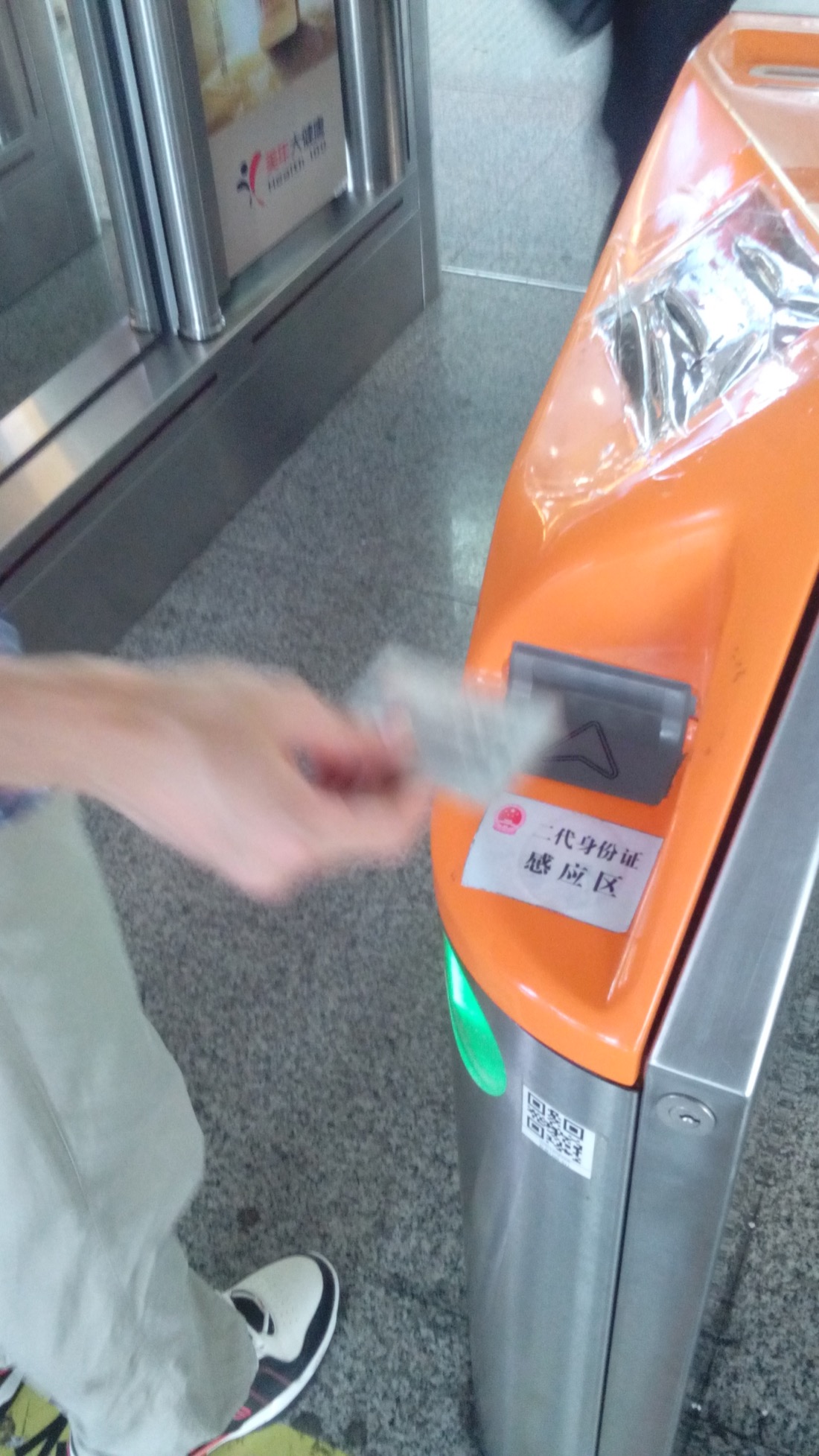
Save the full departure station in Chinese. Confirm it again before leaving the hotel. Use the passport tied to the booking, and allow extra time on the first rail journey for security, wayfinding or a staffed lane.
The official 12306 guidance treats the purchasing identity document as part of real-name ticketing and boarding. Your passport data is not profile decoration.
The address should be usable by the person helping you
An English booking page is optimized for you. A Chinese address is optimized for the driver, station staff member or passerby trying to help.
Keep the destination name, full address and phone number in Chinese as plain text and an offline image. Add the entrance, terminal or pickup point when it matters. “The hotel” can be a tower, a complex or a name shared by several properties.
Do not wait for a weak signal at the curb to discover that the address lives behind an app login.
Verification should happen before the queue
Some setup failures are not visible until the first real transaction: identity review unfinished, card authorization blocked, phone locked to a carrier, passenger name mismatched, or an account asking for a code sent to a disabled SIM.
Open every critical route before departure. A screen that merely shows an app icon or added card is not proof that the workflow is complete. Look for the point at which the service has accepted the identity, funding method or passenger record.
Then save the result into your trip plan so a later policy or booking change prompts a recheck instead of silently invalidating the setup.
“Works in China” is incomplete without the configuration
Travelers can honestly report opposite outcomes. One used home roaming on a phone; another used hotel Wi-Fi on a laptop. One remained logged in; another needed a verification code. One tested last week; another repeated advice from last year.
When reading a recommendation, look for four details: date, device, network lane and exact task.
Without them, treat the report as a clue, not a conclusion. This is especially important for VPNs, travel eSIMs and app availability, where commercial rankings can outlive the conditions they describe.
The first-hour pack is more useful than the perfect app stack
Before you land, make one offline folder containing:
- your first accommodation in Chinese;
- the airport-to-hotel route and backup;
- booking confirmations;
- the entry-policy evidence relevant to your itinerary;
- an offline translation option;
- emergency and accommodation phone numbers;
- the information needed to reach your bank or recover a critical account.
This pack does not replace live services. It gives you a calm first hour while you establish them.
Help becomes easier when you show the right object
If something fails, show the person the artifact closest to the problem:
- the Chinese address, not a paragraph explaining where the hotel is;
- the passport and booking record, not only a train screenshot;
- the exact wallet error, not another scan attempt;
- the app or website name, not “the internet is broken”;
- the official policy page, not a creator’s summary.
Good preparation is partly about making the problem legible to someone who can solve it.
Bottom line
China rewards travelers who arrive with exact identity data, usable Chinese addresses, independent payment and connection routes, and critical information stored offline.
The country is not asking you to become an expert before landing. It is asking your travel system to survive one ordinary failure without turning it into a crisis.
Next: run the 72-hour checklist, then keep My Trip as the current record of what is ready and what needs checking again.